Journal "Open Science and Innovations" is a peer-reviewed scientific electronic journal of "diamond" open access (no APC charges for authors, free access to content).
Publication in the journal is free of charge.
Year of establishment: 2023. First issue: March 2024.
Founder and publisher: State Scientific and Technical Library of Ukraine
ROR ID 019tz0c71
DOI publisher prefix: 10.62405
Frequency: twice a year. Manuscript submissions are accepted annually by April 1 and October 1.
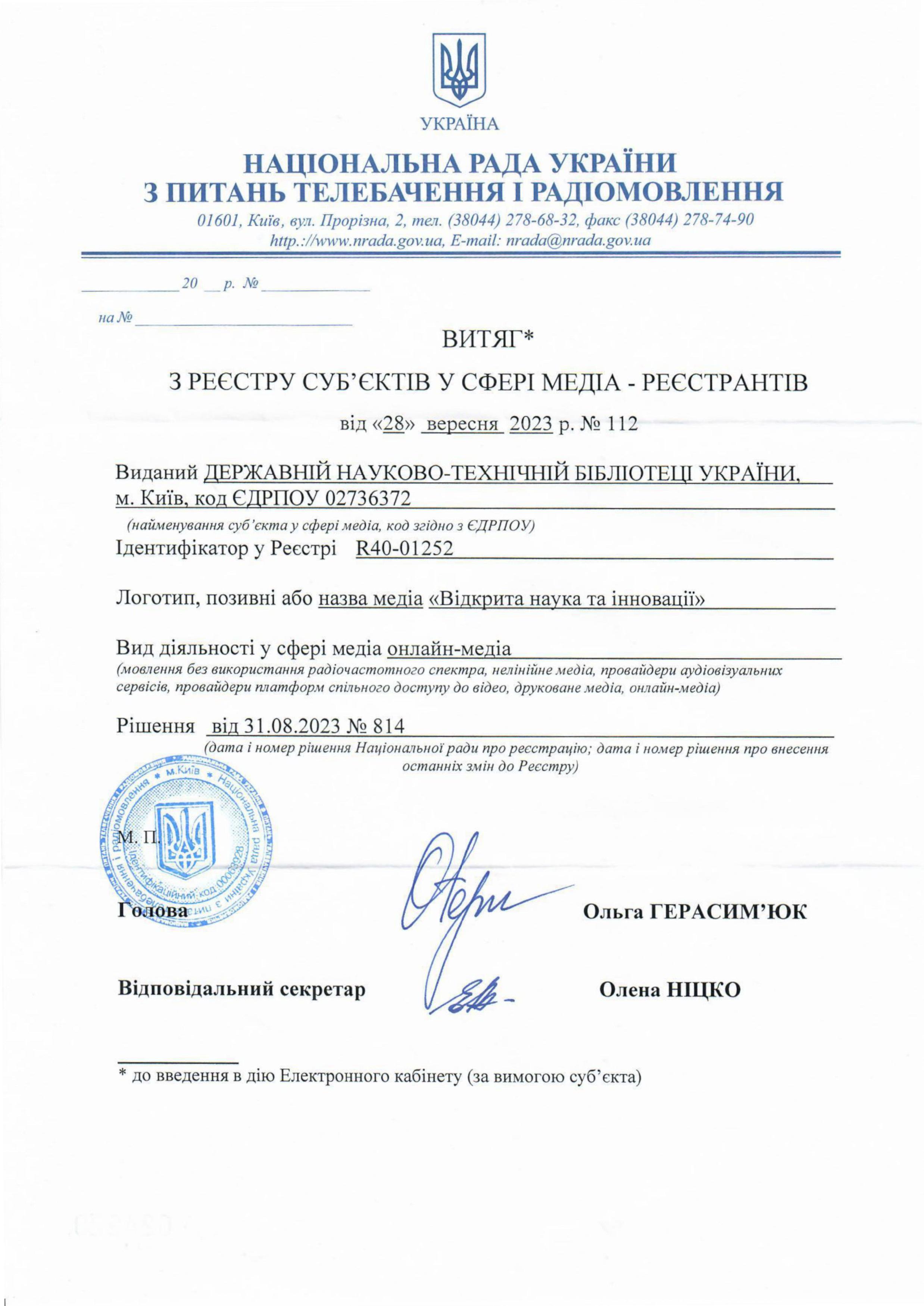
e-ISSN: 3041-1416 Media identifier: R40-01252
Scope: Cluster — Human Capital Development, Social Sciences and Journalism.
The mission of the journal is to explore openness as a principle for organising scholarly knowledge: open science, open access, open data, open peer review, and open infrastructure.
The journal considers for publication articles presenting the results of scholarly research and the implementation of research practices in the fields of open science, open access, open data, open peer review, open methodology, open educational resources, and open-source software; the development of research infrastructure; citizen science; the operation of publication and data repositories; research data management based on the FAIR principles; key trends and strategies in academic publishing; digital science services and applications; the impact of artificial intelligence on the research process and on library and information technologies; digital humanities; scientometrics and bibliometrics; the creation of digital libraries and the management of electronic resources; data journalism and science journalism; and source transparency and data verification as a shared concern of fact-checking and open peer review.
We welcome submissions from researchers in social communications, journalism, information technology, library science, sociology, education, and related fields, provided that the manuscripts fall within the scope of the journal. The decisive criterion for acceptance is the subject of the research rather than the author's disciplinary affiliation.
Articles on educational topics are considered provided that the object of research is open educational resources, open data, scholarly communication, or the development of open science and research data management competencies. Papers on the teaching methodology of individual disciplines that do not include the specified component are not accepted for consideration.
Manuscript languages: Ukrainian, English.
Manuscripts are submitted via the journal website (sections "Register" or "Login") or by email at [email protected]. All correspondence with the editorial office throughout the manuscript processing is conducted via the same address.
The journal is guided by the highest standards of publication ethics and academic integrity, adhering to the principles and recommendations of leading international organizations and declarations: COPE (Committee on Publication Ethics), WAME (World Association of Medical Editors), DORA (Declaration on Research Assessment), and others.
Adherence to COPE Principles The editorial board fully supports and implements the Core Practices of COPE regarding publication ethics, including: making publication decisions solely on the basis of scientific quality and relevance; maintaining confidentiality of manuscripts and the review process; equal treatment of all authors regardless of origin, gender, religion, or political beliefs; and transparency of procedures and criteria for editorial decisions.
For authors: Originality (submission of only original, previously unpublished research); Accuracy (responsibility for the correctness and reliability of the data provided); Full disclosure (declaration of all conflicts of interest and funding sources); Authorship (inclusion in the author list only of those who made a significant contribution to the research).
The journal applies COPE Flowcharts to address ethical dilemmas and violations (suspected plagiarism, data fabrication or falsification, disputed authorship, conflicts of interest, etc.).
Adherence to WAME Principles The editorial board also recognizes the value of WAME recommendations for maintaining high standards of scientific publishing, particularly regarding ethical standards for research involving human subjects (mandatory ethics committee approval, obtaining informed consent from participants, ensuring confidentiality of personal data in accordance with GDPR and national legislation, etc.).
Conflicts of interest: clear identification and disclosure of financial and non-financial conflicts of interest; transparency regarding research funding sources; independence of editorial decisions from commercial interests.
Research Data Policy: The journal recommends that authors provide open access to the research data underlying the publication by depositing them in data repositories (e.g., the National Repository of Research Data, Zenodo, Figshare, OSF, etc.) and including a corresponding reference (DOI or DID) in the article. If full disclosure of data is not possible due to confidentiality or legal restrictions, authors are asked to inform the editorial board of the reasons, but may provide access to the data upon reasonable request.
Reporting standards: adherence to international reporting standards (CONSORT, STROBE, PRISMA, etc.), full disclosure of methodology and research limitations, and ensuring reproducibility of results.
Peer Review Policy: The journal conducts mandatory double-blind peer review.
Support for the DORA Declaration: The journal fully endorses the San Francisco Declaration on Research Assessment (DORA) and commits to focusing primarily on scientific content rather than quantitative publication or journal metrics; promoting diverse evaluation metrics, including alternative indicators (altmetrics); taking into account various types of research outputs (data, software, patents, etc.); and supporting and encouraging authors toward open access and open science. Publication decisions are made solely on the basis of scientific quality and novelty, with no discrimination based on the "prestige" of an author's previous publications.
The journal is registered with the National Council of Ukraine on Television and Radio Broadcasting. Media identifier: R40-01252 (Decision of the National Council of Ukraine on Television and Radio Broadcasting No. 814 of 31.08.2023).
The journal operates on the Open Journal Systems platform (version 3.4.0.7) — open-source software developed, maintained, and freely distributed by the Public Knowledge Project under the GNU General Public License.
The journal is indexed in DOAJ, Crossref, OUCI, Google Scholar, and other search engines, and is additionally archived at the State Scientific and Technical Library of Ukraine, the Vernadsky National Library of Ukraine, and in the LOCKSS Program (Lots of Copies Keep Stuff Safe) — an innovative system for long-term digital preservation and archiving (plugin between OJS and LOCKSS).